Kamis, 14 Mei 2015

12 Ways to Learn While Playing with Food (Love to Learn Linky #42)

We all have probably told our kids at one time or another to not play with their food! Well, sometimes you can let them play and use it as a learning experience. Here are some awesome ideas for learning with common snack foods including goldfish, oreos, M&Ms, crackers and more!

12 Ways to Learn While Playing with Food

How about some STEM learning with goldfish crackers? Use these free Goldfish Printables to practice math skills, and see how to engineer a Goldfish pulley system.

Read the book Brown Bear, Brown Bear and try this color matching activity with Teddy graham crackers.

Sort your lunch into different shapes with this free Shape Sorting Printable.

Have a blast cutting up your food with this Scissor Skills Lunch activity.

Got M&Ms? Practice spelling words with these free M&M Word Printables, and have fun counting with this M&M School Bus Math game (also includes free printable).

Try one of these 8 creative ways to learn with Oreos.

Learn about constellations with Fruit Gummies and this free printable.

Practice addition with these free Jellybean Math printables.

Make your own Very Hungry Caterpillar out of these healthy snack foods.

Learn to count to 100 with Skittles in this free printable basketball game.

LOVE TO LEARN LINKY

Visit my co-hosts to see their posts and features!

Fun Ways to Paint with Kids from A Little Pinch of Perfect

Love to Learn Linky

Now it's time for some more links! I hope you'll join me and a couple of friends for a brand new linky party!

Bloggers, link up your posts every Thursday and watch as we round them up and share them all over the place.

Almost anything goes, we're just hoping your activities teach kids (or us!) something. (science, art, cooking, behavior, crafting, parenting, etc...)


Love to Learn Linky Etiquette:

  • Posts should be about educating our kids in any way - science, art, cooking, crafts, behavior, parenting, etc. Please keep them family friendly and please no Etsy shops or giveaways unless they are relevant to the topic.

  • Upload your direct post link to the InLinkz widget. Link up to 3 posts.


  • Post our button on your site.

  • By linking up, you agree to have your images shared with credit.

Link up and grab a button!
Love to Learn Linky


Rabu, 13 Mei 2015

Learning with Colored Straws

Hi, My name is Nicola and you can usually find me over at http://www.multicraftingmummy.com. My blog is full of ideas for arts, crafts and messy play activities for children aged 2-7 to do together. When my two sons are in school, I also like to tackle hands-on learning activities with my 3 year old daughter. Today I am delighted to be sharing a series of learning activities ideal for toddlers, using coloured straws to work on colour recognition, scooping and pouring and making basic shapes.


Learning with Colored Straws

Straws are a very handy material to have in your learning and crafting supplies, as they can be used for so many fun activities. We put ours to good use in this Rainy Day Bubble Blowing activity recently (this project took bubble painting to a whole new level!). I have also been using a packet of coloured straws with Bella, my 3 year old daughter, in a series of learning activities.


Colour Recognition

I cut up a selection of red, yellow, blue and green straws into pieces around 4 cm long and 4 matching coloured discs of paper. I laid the coloured discs out on the table and put the pile of mixed up coloured straws in front of my toddler.


I began the activity asking her what colours the pieces of straws were that I was pointing too. She did very well with this. I then asked her to take each piece of straw and match it up to the corresponding coloured disc of paper. All the time I was talking to her and asking her questions about the colours of the straws that she was handling. I didn’t pull her up too much when she got the odd one wrong, as I didn’t want to discourage her at this stage. I gave lots of praise when she matched the straws up correctly and then gently corrected her when she got one of them mixed up.


Making Shapes

We then used the pieces of straws to make some basic shapes. We worked together on this all the while talking about the different shapes that we were creating and which were her favourites.


Pour and Scoop


I added in a plastic jug and bowl into our dish of straws for Bella to work on her scooping and pouring skills. She had great fun serving me pretend cups of tea and ice-creams. I was very full by the end of it!


Getting Messy

Bella loves to get messy and playing with shaving foam is one of her favourite messy play ingredients. To incorporate her love of getting messy with a fine motor skills activity we used the coloured straws again but this time added in shaving foam and gold coins. Unfortunately she quickly abandoned the tweezers and just got stuck in with her hands, but that’s doing activities with toddlers for you!


More activity ideas for rainbow straws:

-Help your child to make their name with them.
-Work on colour sequencing making different patterns with them.
-Create some art work with them.

What other ideas can you add?

If you enjoyed this post you might like to pop over and read Sensory Soup and Fine Motor Fishing.


Meet Nicola:
Nicola enjoyed a successful career as a Librarian in the media and legal sectors before settling down to life as a stay at home mum to Liam 7, Freddie 5 and Bella 3. They live by the sea in Ireland and enjoy doing arts and crafts, almost as part of their daily routines. You can follow her on her blog, on Facebook, Pinterest, Twitter and Instagram.


Minggu, 10 Mei 2015

Bread Science Experiment + Free Printable Bread Cutting Pack

My next guest blogger is one you will definitely want to visit: Kristin from SmartE partE! Kristin is a homeschooler who blogs about her tot-school and preschool learning activities, themes, and free printables. She specializes in tot and prek "trays", such as her Hockey Tot Tray + Free Hockey Pack, 12 Science Preschool Trays + printables and 15 Spring Preschool Trays + printables.


Sourdough Bread Science

Long ago, my husband took a job as a bagel baker, which led to a career in bread baking. Sourdough was just a way of life! It took until later to understand the science behind it.

The actual maintenance of a sourdough starter is likely outside the scope of preschool science. If you are interested in learning more today, Cultures for Health has some helpful tips, videos and projects all about sourdough! We wanted to share an easy-prep science experiment that can be done with regular yeast and everyday household liquids. 


Yeast + Liquid Science Experiment + Free Printable

For this simple experiment, you will need:

-Yeast (not instant)
-Various liquids (see below)
-Cups or bowls
-This printable

You could try this with any liquids you like! Other than the various water temperatures, be sure to have the liquids at room temperature.

-Ice water
-Warm water
-Hot water
-Soda water
-Almond milk
-Dairy milk
-Apple juice
-Cider vinegar
-Soda w/ sugar
-Soda w/ corn syrup
-Soda (Diet)
-Water & baking soda (let sit 5 min before using)
-Water & aspirin (let sit 5 min before using)

Simply mix about 1 tsp. of yeast into 4-6 oz. (or 1/2 - 3/4 C) of liquid in a cup or bowl. Label or note each mixture. Watch mixtures as they change. Look from above and record the results on the printable! (We used dollar store plastic cups for this. But, another option would be to do these mixtures within Ziploc bags! Please be wary though as the bags could explode due to the activity of the yeast.) We were surprised at what liquids had the strongest reactions. We invite you to investigate this, too!

Download the Yeast + Liquid Bread Science Printable here! 


Bonus: Free Bread Cutting Pack


Though my boys make bread all the time, I decided to have a special Bread Preschool Week in our homeschool. So, I have created a free, printable bread mini-pack that I am honored to share with Totschooling readers! I always appreciate the free printables from Totschooling that makes our homeschool preschool journey oh-so much easier!


Free Printable Bread Cutting Pack

This bread mini-pack includes:

-Cutting Strips
-Cutting Shapes
-Slicing Bread
-Symmetry 

Download the Bread Cutting Practice Pack here!

Thank you for reading! I hope you enjoy learning about bread and how it works in your homeschool!


Meet Kristin:

Hi! I am Kristin and I blog over at smartEpartE.com. When our son, E was 2 I jokingly called him a "smarty party," hence the name of the blog! It served as inspiration to keep up with weekly tot school themes, and perhaps, share some ideas with others! Thank you for visiting over at smartEpartE.com or on Pinterest!


Senin, 04 Mei 2015

5 Skills to Teach Your Tot that Will Lead to Reading Comprehension

Reading comprehension skills can easily make children soar as wonderful independent readers or a lack of can leave them frustrated, confused, and upset. Adding a few simple techniques to your toddler’s story time can give him a great foundation of reading comprehension skills even before he is an independent reader. Try some of these easy techniques to make the most out of story time with your tot.


1. Make Predictions


Before reading a story with your tot, take a picture walk through the book. Look at the pictures together and describe what it looks like is happening. Ask questions like, “How do you think this character feels? What do you think is making him sad?” This will help your child to look for details in the pictures while you read the story and it will help him make predictions about what is going to happen. While reading the story, stop before turning the page occasionally to ask, “What do you think will happen next?” This will help to build his internal dialog of how to make predictions while reading.


2. Make Connections


Connections can be made before, during or after a story is read. Help your child to see similarities between events or characters in the story and in her own life. Maybe a character has a dog like your kiddo, maybe they both like pizza. After reading a story, you might find yourself in a similar situation as a story you read. Take this learning opportunity to bring up the story and remember what happened to the characters. Connecting a story to a tot’s life brings the story to life for her and really helps her to understand it better.


3. Ask Questions


Asking your tot questions, even if he might not be able to answer them yet will help to build his internal dialog that will help him to understand stories for many years to come. Try asking questions before, during, and after reading a story. Here are some questions you might ask.

Before Reading
What do you think this story will be about?
Why do you think the character is doing or feeling like this?
How do you think they will solve the problem?

During Reading
What do you think will happen next?
What would you do if this happened?
Why did the character do that?
What started this argument?

After Reading
What did this story remind you of?
How could the characters have acted in a better way?
Why do you think the story ended like that?
What was your favorite part?
Who was your favorite character?


4. Think Out Loud


Thinking out loud while reading with your tot will teach her how to respond to a story, to monitor her own understanding and to clarify confusions when she becomes an independent reader. Your example will help to shape her internal dialog or self talk as she reads.

Thinking out loud is really just as simple as it sounds. If you get to a point in the story where you don’t understand something, say what you are thinking. It might sound like, “Why did they go to the store again? Let me look at that last page once more. Oh yeah, they forgot to get sugar while they were talking to their friends.” This simple technique will help your child to become very skilled at monitoring her own understanding when she is reading on her own.


5. Act It Out


Acting stories out adds a greatly needed element of play to reading with toddlers. It also helps to bring stories to life. Tots love to engage in make-believe play and will soon be independently incorporating stories into make-believe play.

You may also use dress –up clothes, figurines, toys, and puppets to help children act out stories from books. Let your kiddo choose what seems most interesting and introduce him to new ways to act stories out over time.


5 Skills to Teach your Tot that will Lead to Reading Comprehension

Interested in learning more about developing your child’s language and literacy skills? Click here to get the FREE guide: 5 Early Literacy Toys that will SKYROCKET Your Child’s Language Skills.


Meet Lindsay:

Lindsay Drewes is a former 4th and 5th grade teacher and current stay-at home-mom and Momprenuer of Kiddo Korner. Lindsay holds both a bachelor's and master's degree in education. As founder of KiddoKorner.com, Lindsay followed her passion of mothering to research and offer the best educational, Eco-friendly and innovative products made for babies and toddlers.


Kamis, 30 April 2015

Free Alphabet Butterfly Puzzles (Love to Learn Linky #40)

Puzzles are a great hands-on way for kids to learn. They are a favorite at our house! My daughters love the challenge of solving puzzles and putting pieces together to create a picture. With Spring here I thought it would be fun to practice our alphabet and letter cases using this set of colorful, free printable Butterfly Puzzles.

Free Alphabet Butterfly Puzzles

This set includes 26 different butterflies with an uppercase letter and lowercase letter on each wing.

Since all the butterflies are unique, it is a great way for kids to check their own work to make sure the butterflies and letters match up. Great for independent and quiet time!


LOVE TO LEARN LINKY

Visit my co-hosts to see their posts and features!

Spring Activities for Toddlers & Kids from A Little Pinch of Perfect
Inspiring Kids to Protect Our Oceans: Oil Spill Activity from One Time Through
Love to Learn Linky

Now it's time for some more links! I hope you'll join me and a couple of friends for a brand new linky party!

Bloggers, link up your posts every Thursday and watch as we round them up and share them all over the place.

Almost anything goes, we're just hoping your activities teach kids (or us!) something. (science, art, cooking, behavior, crafting, parenting, etc...)


Love to Learn Linky Etiquette:

  • Posts should be about educating our kids in any way - science, art, cooking, crafts, behavior, parenting, etc. Please keep them family friendly and please no Etsy shops or giveaways unless they are relevant to the topic.

  • Upload your direct post link to the InLinkz widget. Link up to 3 posts.


  • Post our button on your site.

  • By linking up, you agree to have your images shared with credit.

Link up and grab a button!
Love to Learn Linky


Selasa, 28 April 2015

Playful Alphabet Garden with Free Printable

I am very excited to announce my next super talented guest blogger: Sue from One Time Through. She has many amazing parenting posts and great educational ideas. Also be sure to check out her (free printable) Parent & Child Connection Coupons

Playful Alphabet Garden

Spring is arriving late to my neighbourhood this year, so I decided to get a head start and create a playful alphabet garden for my 3 year old son to plant inside. I'm Sue and you can usually find me blogging about hands-on learning activities for young kids over at One Time Through.

Because I'm a teacher, I often try to find a way to turn fun activities into learning opportunities and I thought this idea would be perfect to share with the Totschooling readers!


I found the idea for a playful alphabet garden at my local early years drop in centre where they often share creative and fun ways to introduce young children to their letters.

My son didn't have enough time to really play with the "garden" that day - so I decided to make my own at home for him to use.

What is the Playful Alphabet Garden?

The alphabet garden is a simple plastic tub filled with play sand, a pair of child- sized garden gloves, some small gardening tools, a few plastic plant pots, a small watering can, and of course, the popsicle stick alphabet "flowers."

The flowers (as well as a few bugs and butterflies for fun!) each have a capital letter of the alphabet on them. I created a printable PDF A to Z set of these that you can download for free {HERE}.

How to Prepare the Garden

You Will Need:

- the Playful Alphabet Garden printable (1 or 2 copies)
- 26+ popsicle sticks
- play sand and a plastic tub/container
- small garden gloves, planting tools, watering can, and plastic plant pots

To set up the garden activity, print off your alphabet flowers and cut them out. I decided to print out 2 copies so that I would have lots of letter doubles. I also laminated mine so that they would last longer. Tape each flower/bug to the top of a popsicle stick.

I also found some small plastic flower pots that I wrote some garden-related words on with a permanent marker, like: water, dirt, rocks, flower, and my son's name (a big favourite right now!)


Garden Play

When my son first played with the bin, I didn't give him any instructions except to put on his gardening gloves. His first instinct was to scoop the sand and fill the pots, and dig, dig, dig! And that was okay with me.

After some exploratory play, I showed him how he could "plant" the flower letters in each pot to match the words on the pots. We did this activity for a little while together - focusing on his name and then one of the plant pot words that he was interested in (incidentally the one that also started with the first letter of his name).

Eventually, his focus moved back to scooping and digging, but the letter flowers now became a part of his pretend play.


I got this gardening activity out several times this week, and each time my son seemed to get something different out of it. The first day was about exploring, the second day was more about pretending to plant flowers, and the third time was more about matching the letters to the words.

In all cases, he was having fun, learning to recognize the letters, and by talking with me as he played, incidentally learning letter sounds. All perfect practice activities for an early writer!


Meet Sue:

Sue is an Elementary School Teacher currently on leave to be at home with her preschooler son. She shares ideas for connecting and learning with kids through meaningful, play-based activities that nurture curiosity and creativity, as well as positive parenting tips.


Senin, 27 April 2015

Gone Fishing Game for Preschoolers

I can't wait to try this super fun and educational "fishing" game created by Tiffiny from Spark and Pook. Tiffiny is an elementary school teacher turned stay-at-home mom, blogging about playful learning ideas, children's books and traveling with kids. Be sure to check out her (free printable) Make Way for Duckling Matching Activities and her 10 Apples Up on Top Book Activity.

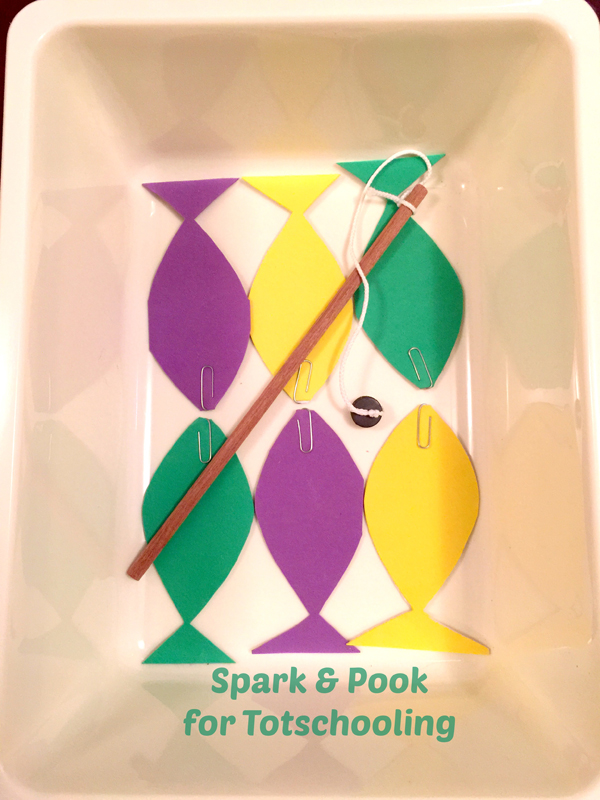
Gone Fishing Game

For my daughter’s third birthday party, I put together a game I call “Gone Fishing” using simple materials I happened to have around the house. The game was such a hit with Pooky and the other kids that I decided to share it with you. The game is quick to set up and provides oodles of educational fun (a win-win in my book).


What you will need:

- Gone Fishing Printable (or draw your own simple fish outlines)
- small dowel rod (you can also use a wooden spoon or unsharpened pencil)
- baker's twine, yarn, or some form of thick string (about 10-12 inches in length for each "fishing pole")
- construction paper or foam sheets in a variety of colors
- paper clips (one per fish)
- dot magnets
- a "pond" of some sort in which to place the fish


Assembly:

1 - Make the fish. I wanted more durable fish, so I printed the Gone Fishing Printable onto plain paper and then used that to trace and cut foam fish in a few different colors.  If you don't have or want to use foam, just print the fish onto colored construction paper, and then cut them out. I created a total of nine fish for our game, but you can make as many as you'd like.

2 - Once the fish are cut out, attach a paperclip to each fish in the place where a mouth would go.

3 - Assemble the fishing pole by tying a double knot of one end of the string to one end of the dowel rod (or the straight end of a wooden spoon). Using the other end of the string, tie a double knot around the dot magnet. (If using foam fish for the game, use two dot magnets together instead of one.)

4 - Place the fish inside their bucket (or makeshift pond).


Ways to Play:

- Since we had multiple players ranging from ages 2-3, I made a "fishing pole" for each fisher. The initial goal was simply for each child to "catch" a fish with their "fishing pole" (without touching the fish with their hands). For toddlers, this takes a good deal of concentration and coordination. Pooky and her friends played this game repeatedly taking turns to catch the 9 fish.

- Once children become skilled at using the "fishing pole," challenge them further by asking them to fish for a specific color. (This takes greater hand-eye coordination.)

- You can practice other skills by drawing shapes, numbers, or letters onto the fish and asking the child to "fish" for specific ones.   (To make the fish re-usable use a small sticky note instead of drawing directly onto the fish.) See the examples below.

- Write numbers on the fish (one on each) and have the child "fish" for the numbers in order. If they accidentally "catch" the wrong number, throw it back in.

- Draw some shapes that your child is familiar with on the fish so that there are multiples of each shape (i.e. three fish with a square, three fish with a circle, etc...) Create a landing spot for each type of fish so the child can sort their fish into the correct shape "bucket."

- Label the fish with some letters your child has been learning. Choose only a few letters and mark one fish with the capital letter and another fish with its corresponding lowercase letter. Then have the child fish for a specific letter and match the uppercase and lowercase into pairs.


Those are the ways we've been playing "Gone Fishing," but I'm sure there are many other ways you could play. Once Pooky knew how to play, we turned it into a Busy Bag activity. I take it out periodically and it's fun and educational all over again. You can find more busy bag ideas here.

Skills addressed with this activity:

- gross motor: hand-eye coordination
- social skills: taking turns
- math: counting, sorting, ordering, matching
- literacy: letter identification

Happy Fishing!


Meet Tiffiny:

I am a certified elementary school teacher turned stay-at-home mom. I’m a foodie, traveler, and avid reader. I love to share these joys with my husband, daughter, and the blogosphere. On my blog, Spark and Pook, you will find tips for traveling with children, children’s book reviews, and learn-though-play activities for toddlers and preschoolers.